
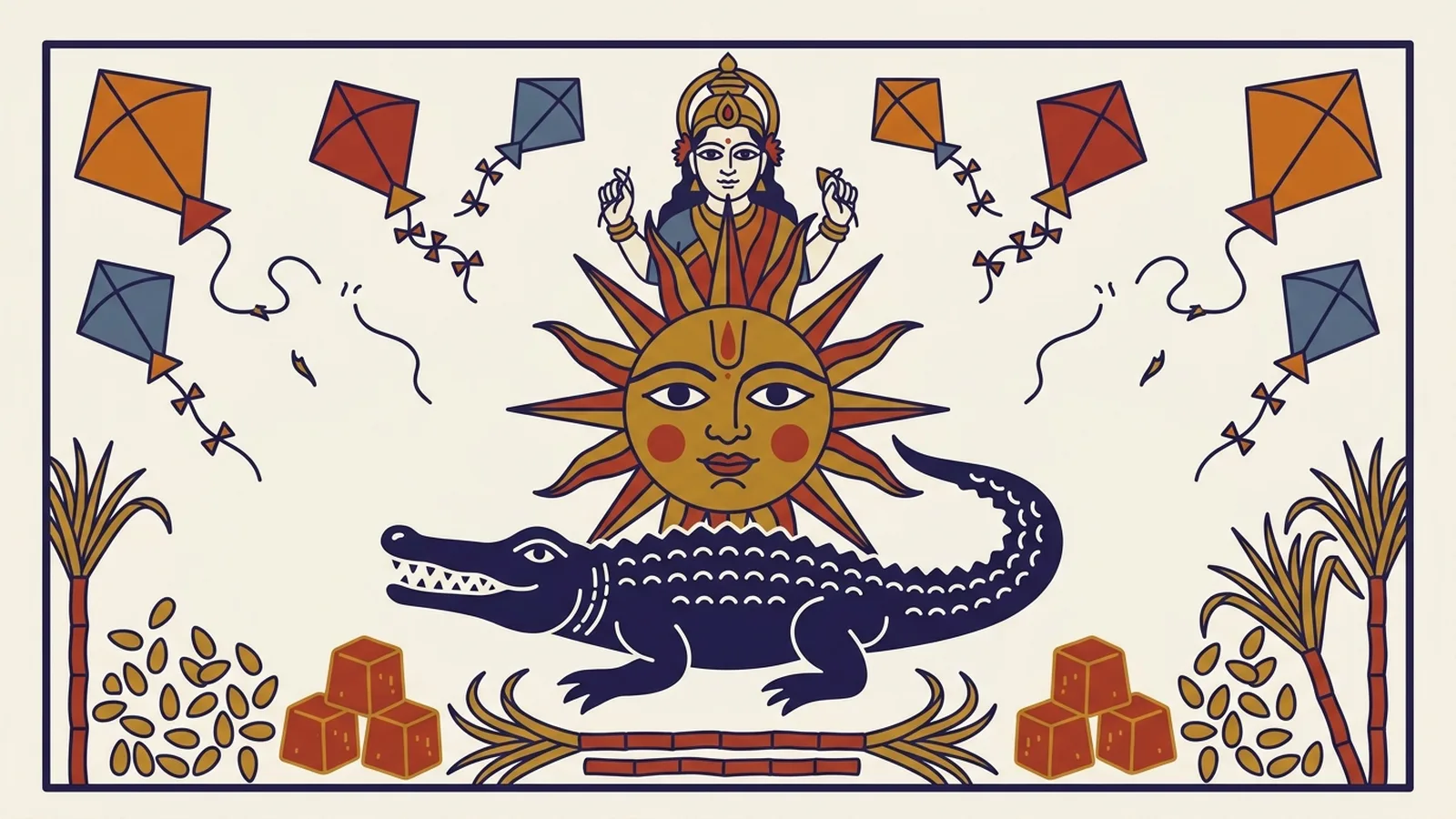
Makar Sankranti illustration

Solar sankranti

Pausha Shukla Paksha

Makar Sankranti 2027मकर संक्रांति

Makara Sankranti marks the Sun's entry into the sidereal sign of Capricorn and the start of its northward course.

Date · New Delhi (28.6139° N, 77.2090° E)

Thursday, 14 January 2027

Samvat

Vikram 2083 · Shaka 1948

Tradition harmony

All regional traditions Chakra tracks agree on this date:

North (Purnimanta)
14 Jan 2027
South (Amanta)
14 Jan 2027
Tamil
14 Jan 2027
Bengali
14 Jan 2027
ISKCON
14 Jan 2027
Smarta
14 Jan 2027

Tithi window

Begins 14 Jan, 9:15 pm

Ends

Abhijit Muhurta

12:09 pm – 12:51 pm

Universal auspicious midday span

Masa note

Nija (Shuddha) Pausha

No intercalary month interference this year.

January 2027

S
M
T
W
T
F
S
1
2
5
8
9
10
11
13
14
15
17
18
21
23
24
26
27
28
29
30
31
  • 14 ThuMakar Sankranti(this page)Makara Sankranti marks the Sun's entry into the sidereal sign of Capricorn and the start of its northward course.

Also this month: Ekadashi (2), Pradosh Vrat (2), Masik Shivratri (1), Amavasya (1), Vinayaka Chaturthi (1), Masik Durga Ashtami (1), Purnima (1), Satyanarayan Puja (1), Sankashti Chaturthi (1).

Local horizon calculations

City-wise timings

CityLocal dateTithi window (local)vs. New Delhi
New Delhi14 Jan 2027Same day
Varanasi14 Jan 2027Same day
Mumbai14 Jan 2027Same day
Bengaluru14 Jan 2027Same day
Kolkata14 Jan 2027Same day
Chennai14 Jan 2027Same day
London14 Jan 2027Same day
San Francisco14 Jan 2027Same day

Tithi window shown in each city’s own local time — the underlying instant is the same worldwide.

Makara Sankranti is one of the few Hindu festivals fixed to the solar calendar rather than the Moon, so it falls on roughly the same Gregorian date each year, in mid-January. It marks the moment the Sun enters Makara, the sidereal sign of Capricorn, and begins Uttarayana, the half-year in which it climbs higher in the sky. The day is associated with the end of the coldest weeks, with sesame and jaggery sweets, ritual bathing in rivers, and gifts to those in need. The Aditya Hridayam, the Ramayana hymn to the Sun, is the natural recitation for the day.

Because the festival tracks the Sun's position against the fixed stars, its date is computed from the sidereal zodiac using the Lahiri ayanamsa; the sankranti instant itself can fall on either side of local midnight, which occasionally shifts the observed day.

Regional forms are distinct: Pongal in Tamil Nadu, Lohri on the eve in Punjab, Uttarayan and kite-flying in Gujarat, Bihu in Assam, and Poush Sankranti in Bengal.

Multi-year archive

Makar Sankranti in other years