
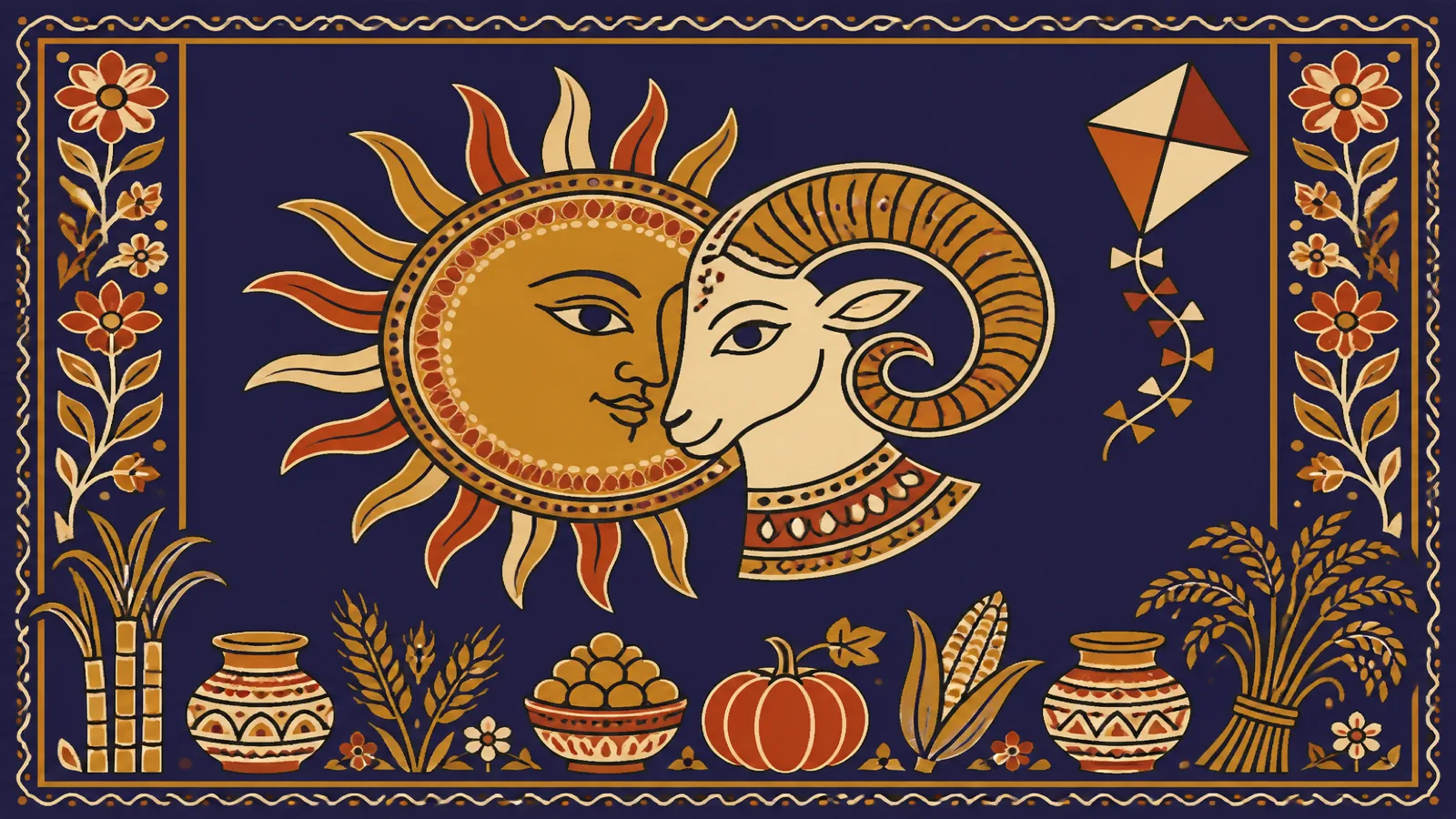
Mesha Sankranti illustration

Solar sankranti

Vaishakha Krishna Paksha

Mesha Sankranti 2026मेष संक्रांति

Mesha Sankranti is the moment the Sun enters the sidereal sign of Aries, beginning the solar year in several regional calendars.

Date · New Delhi (28.6139° N, 77.2090° E)

Tuesday, 14 April 2026

Samvat

Vikram 2083 · Shaka 1947

Tradition harmony

All regional traditions Chakra tracks agree on this date:

North (Purnimanta)
14 Apr 2026
South (Amanta)
14 Apr 2026
Tamil
14 Apr 2026
Bengali
14 Apr 2026
ISKCON
14 Apr 2026
Smarta
14 Apr 2026

Tithi window

Begins 14 Apr, 9:39 am

Ends

Abhijit Muhurta

11:56 am – 12:47 pm

Universal auspicious midday span

Masa note

Nija (Shuddha) Vaishakha

No intercalary month interference this year.

April 2026

S
M
T
W
T
F
S
1
3
4
6
7
8
9
10
11
12
14
18
21
22
23
25
26
29
30
  • 2 ThuHanuman JayantiHanuman Jayanti celebrates the birth of Hanuman, the devoted companion of Rama and a figure of strength and service.
  • 14 TueMesha Sankranti(this page)Mesha Sankranti is the moment the Sun enters the sidereal sign of Aries, beginning the solar year in several regional calendars.
  • 19 SunAkshaya TritiyaAkshaya Tritiya is an auspicious day on which anything begun or given is believed to bring lasting, undiminishing result.

Also this month: Purnima (1), Satyanarayan Puja (1), Sankashti Chaturthi (1), Ekadashi (2), Pradosh Vrat (2), Masik Shivratri (1), Amavasya (1), Vinayaka Chaturthi (1), Masik Durga Ashtami (1).

Local horizon calculations

City-wise timings

CityLocal dateTithi window (local)vs. New Delhi
New Delhi14 Apr 2026Same day
Varanasi14 Apr 2026Same day
Mumbai14 Apr 2026Same day
Bengaluru14 Apr 2026Same day
Kolkata14 Apr 2026Same day
Chennai14 Apr 2026Same day
London14 Apr 2026Same day
San Francisco13 Apr 2026Differs

Tithi window shown in each city’s own local time — the underlying instant is the same worldwide.

Mesha Sankranti marks the Sun's passage into Mesha, the first sign of the sidereal zodiac, corresponding to Aries. The instant is fixed by the Sun's longitude reaching zero degrees measured against the fixed stars, using the Lahiri ayanamsa, and it usually falls in mid-April.

This is a solar reckoning and is independent of the lunar months that govern festivals like Diwali or Holi: it does not depend on a tithi or on the phase of the Moon, only on where the Sun sits along the ecliptic. The observed date can move by a day between cities because the transit instant is converted to local time, and customary practice ties bathing and giving to the sunrise nearest the sankranti.

It opens the year in the solar calendars of several regions and is kept as Baisakhi in Punjab, Pohela Boishakh in Bengal, Puthandu in Tamil Nadu, Vishu in Kerala, Bihu in Assam and Maha Vishuba Sankranti in Odisha.

Multi-year archive

Mesha Sankranti in other years