
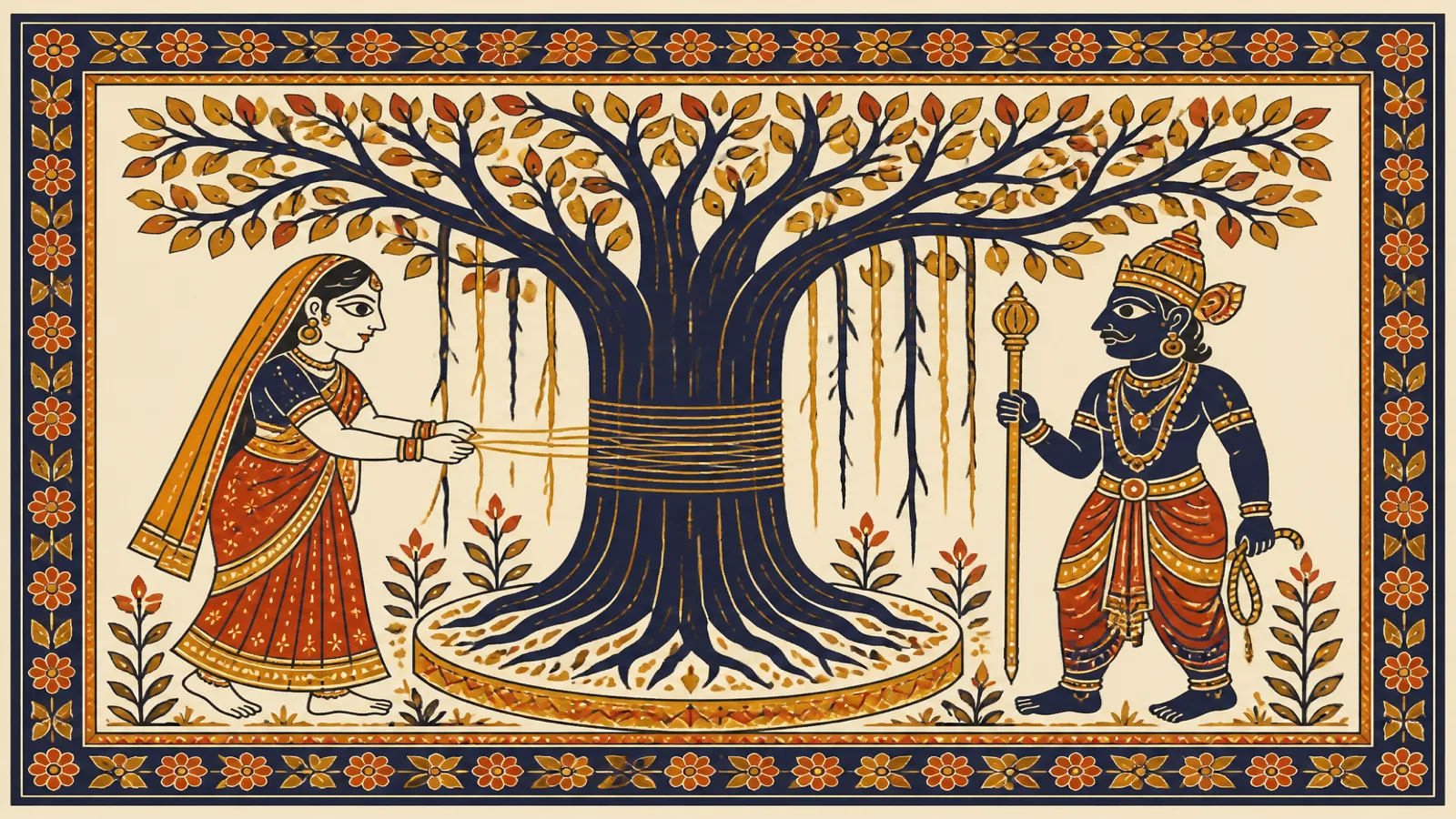
Vat Savitri Vrat illustration

Vrat & fast

Vat Savitri Vrat 2029वट सावित्री व्रत

Vat Savitri Vrat is an austere fast observed by married women worshipping the banyan tree and honoring Savitri's devotion on Jyeshtha Amavasya or Purnima.

Date · New Delhi (28.6139° N, 77.2090° E)

Tuesday, 12 June 2029

Tradition harmony

All regional traditions Chakra tracks agree on this date:

North (Purnimanta)
12 Jun 2029
South (Amanta)
12 Jun 2029
Tamil
12 Jun 2029
Bengali
12 Jun 2029
ISKCON
12 Jun 2029
Smarta
12 Jun 2029

Tithi window

Begins 12 Jun, 5:22 am

Ends 13 Jun, 5:22 am

June 2029

S
M
T
W
T
F
S
1
2
3
4
5
6
8
11
12
13
14
17
18
20
21
24
25
27
28
30
  • 12 TueVat Savitri Vrat(this page)Vat Savitri Vrat is an austere fast observed by married women worshipping the banyan tree and honoring Savitri's devotion on Jyeshtha Amavasya or Purnima.
  • 15 FriMithuna Sankranti →Mithuna Sankranti is the moment the Sun enters the sidereal sign of Gemini, and in eastern India it coincides with the Ambubachi observance.
  • 22 FriNirjala Ekadashi →Nirjala Ekadashi is the strictest Ekadashi of the year, kept entirely without water, and is said to carry the merit of all the others combined.

Also this month: Ekadashi (2), Pradosh Vrat (2), Masik Shivratri (1), Amavasya (1), Vinayaka Chaturthi (1), Masik Durga Ashtami (1), Purnima (1), Satyanarayan Puja (1), Sankashti Chaturthi (1).

Local horizon calculations

City-wise timings

CityLocal dateTithi window (local)vs. New Delhi
New Delhi12 Jun 20295:22 am – 13 Jun, 5:22 amSame day
Varanasi12 Jun 20295:07 am – 13 Jun, 5:07 amSame day
Mumbai12 Jun 20296:00 am – 13 Jun, 6:00 amSame day
Bengaluru12 Jun 20295:53 am – 13 Jun, 5:53 amSame day
Kolkata12 Jun 20294:51 am – 13 Jun, 4:51 amSame day
Chennai12 Jun 20295:42 am – 13 Jun, 5:42 amSame day
London11 Jun 20294:43 am – 12 Jun, 4:43 amDiffers
San Francisco11 Jun 20295:47 am – 12 Jun, 5:47 amDiffers

Tithi window shown in each city’s own local time — the underlying instant is the same worldwide.

Vat Savitri Vrat is a sacred fasting observance practiced by married women for the longevity, health, and prosperity of their husbands and family. The festival draws inspiration from the timeless epic narrative of Princess Savitri, whose unyielding devotion, intellect, and dharmic righteousness compelled Yama, the Lord of Death, to restore life to her deceased husband Satyavan beneath a banyan tree.

The observance falls on the new moon day (Amavasya) of the lunar month of Jyeshtha in Gujarat, Maharashtra, and southern India (Amanta tradition), and on the full moon day (Purnima) of the same month in northern India (Purnimanta tradition, where it is called Vat Purnima).

Women dress in auspicious bridal attire, tie yellow or red sacred raw thread (moli) around the trunk of a sacred banyan tree (Vat Vriksha) while circumambulating it seven times, and offer seasonal fruits, wet soaked grams, and sweets. The banyan tree personifies the immortal Trimurti: Brahma at the root, Vishnu in the trunk, and Shiva in the canopy.

Multi-year archive

Vat Savitri Vrat in other years