
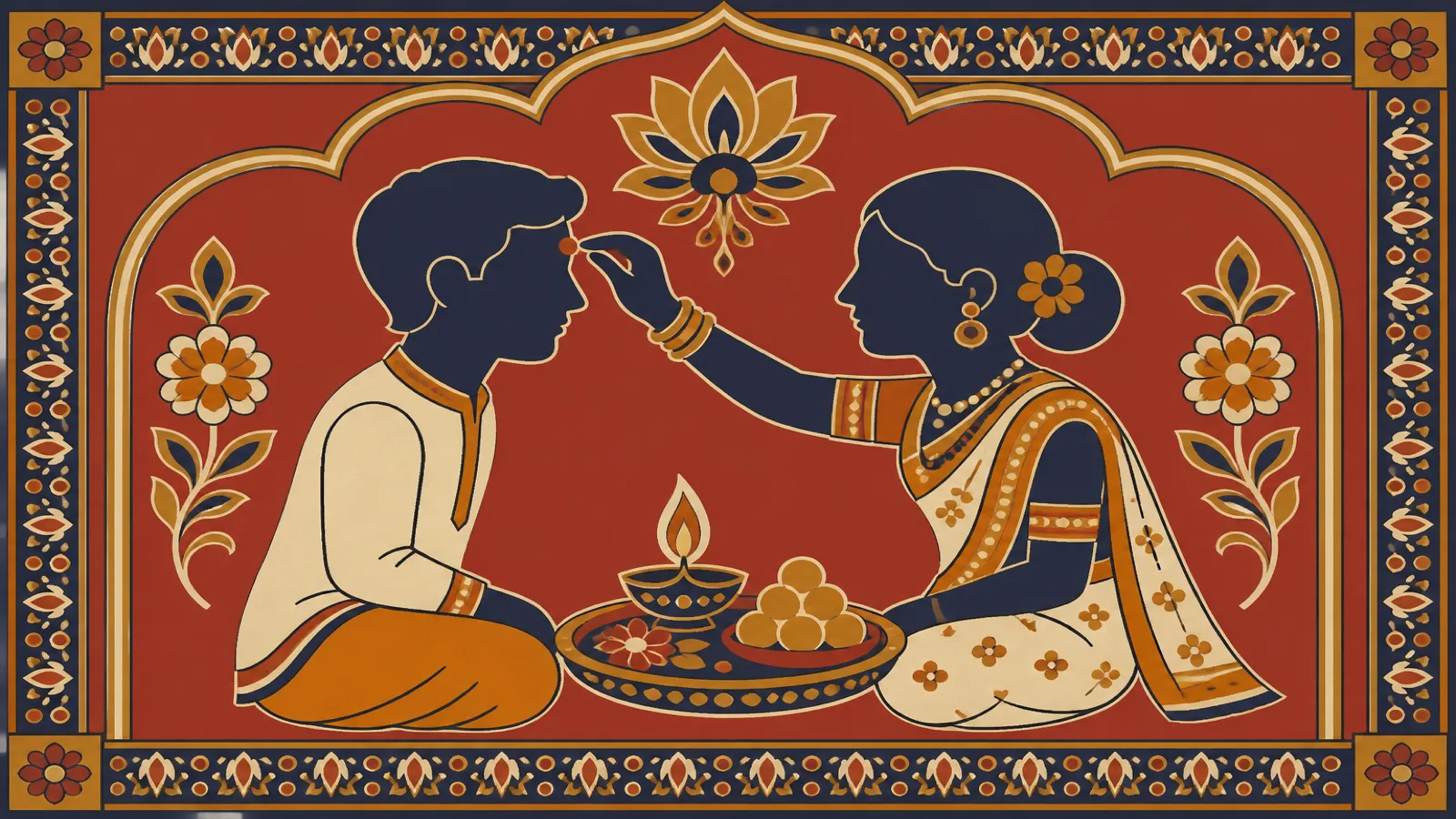
Bhai Dooj illustration

Annual festival

Bhai Dooj 2032भाई दूज

Bhai Dooj is the day at the close of Diwali on which sisters apply a tilak to their brothers and pray for their long life.

Date · New Delhi (28.6139° N, 77.2090° E)

Friday, 5 November 2032

Tradition harmony

All regional traditions Chakra tracks agree on this date:

North (Purnimanta)
5 Nov 2032
South (Amanta)
5 Nov 2032
Tamil
5 Nov 2032
Bengali
5 Nov 2032
ISKCON
5 Nov 2032
Smarta
5 Nov 2032

Tithi window

Begins 4 Nov, 11:46 am

Ends 5 Nov, 11:47 am

November 2032

S
M
T
W
T
F
S
5
6
8
9
11
12
15
18
19
21
22
23
24
25
26
27
29
  • 1 MonNaraka Chaturdashi →Naraka Chaturdashi commemorates the triumph of Lord Krishna and Satyabhama over the tyrant demon Narakasura on Kartika Krishna Chaturdashi.
  • 2 TueDiwali →Diwali is the festival of lights marking the victory of light over darkness and the return of Rama to Ayodhya.
  • 4 ThuGovardhan Puja →Govardhan Puja recalls Krishna lifting Mount Govardhan to shelter the people of Braj, and is kept the day after Diwali.
  • 5 FriBhai Dooj(this page)Bhai Dooj is the day at the close of Diwali on which sisters apply a tilak to their brothers and pray for their long life.
  • 7 SunChhath Puja →Chhath is a four-day festival of thanksgiving to the Sun and the goddess Chhathi Maiya, with offerings made standing in water at sunset and sunrise.
  • 13 SatDev Uthani Ekadashi →Dev Uthani Ekadashi marks the awakening of Lord Vishnu from his four-month cosmic slumber, concluding Chaturmas and opening the Hindu wedding season.
  • 14 SunTulsi Vivah →Tulsi Vivah is the ceremonial wedding of the sacred holy basil plant (Tulsi) to Lord Vishnu in the form of Shaligram on Kartika Shukla Dwadashi.
  • 16 TueVrishchika Sankranti →Vrishchika Sankranti is the moment the Sun enters the sidereal sign of Scorpio, opening the month in which the Kartikai and Mandala pilgrimage seasons begin.
  • 17 WedKartik Purnima →Kartik Purnima is the full moon of the month of Kartika, kept with river bathing, lamp offerings, and worship of Vishnu and Shiva.

Also this month: Masik Shivratri (1), Amavasya (1), Vinayaka Chaturthi (1), Masik Durga Ashtami (1), Ekadashi (2), Pradosh Vrat (2), Purnima (1), Satyanarayan Puja (1), Sankashti Chaturthi (1).

Local horizon calculations

City-wise timings

CityLocal dateTithi window (local)vs. New Delhi
New Delhi5 Nov 203211:46 am – 5 Nov, 11:47 amSame day
Varanasi5 Nov 203211:46 am – 5 Nov, 11:47 amSame day
Mumbai5 Nov 203211:46 am – 5 Nov, 11:47 amSame day
Bengaluru5 Nov 203211:46 am – 5 Nov, 11:47 amSame day
Kolkata5 Nov 203211:46 am – 5 Nov, 11:47 amSame day
Chennai5 Nov 203211:46 am – 5 Nov, 11:47 amSame day
London4 Nov 20326:16 am – 5 Nov, 6:17 amDiffers
San Francisco4 Nov 203211:16 pm – 4 Nov, 11:17 pmDiffers

Tithi window shown in each city’s own local time — the underlying instant is the same worldwide.

Bhai Dooj, also called Bhau Beej, Bhai Phonta or Yama Dwitiya, is the last of the five Diwali days. A sister marks her brother's forehead with a tilak, offers him sweets and a meal, and prays for his health and long life; the brother gives a gift in return. The custom is traced to Yama, the god of death, visiting his sister Yamuna, who received him with a tilak and a feast, after which he declared that any brother honoured this way would be spared an untimely end.

It falls on the second tithi (Dwitiya) of the waxing fortnight of Kartika in the Purnimanta calendar, two days after Diwali. The tilak is generally applied during an auspicious portion of the day, so almanacs give a city-specific window.

The rite resembles Raksha Bandhan but is placed at the other end of the year; in Bengal the Bhai Phonta ceremony is more elaborate, with a paste of sandal and kajal and a set recitation, while in Maharashtra sisters without a brother perform the tilak to the moon.

Read and recite

The katha and prayers for Bhai Dooj

Multi-year archive

Bhai Dooj in other years