
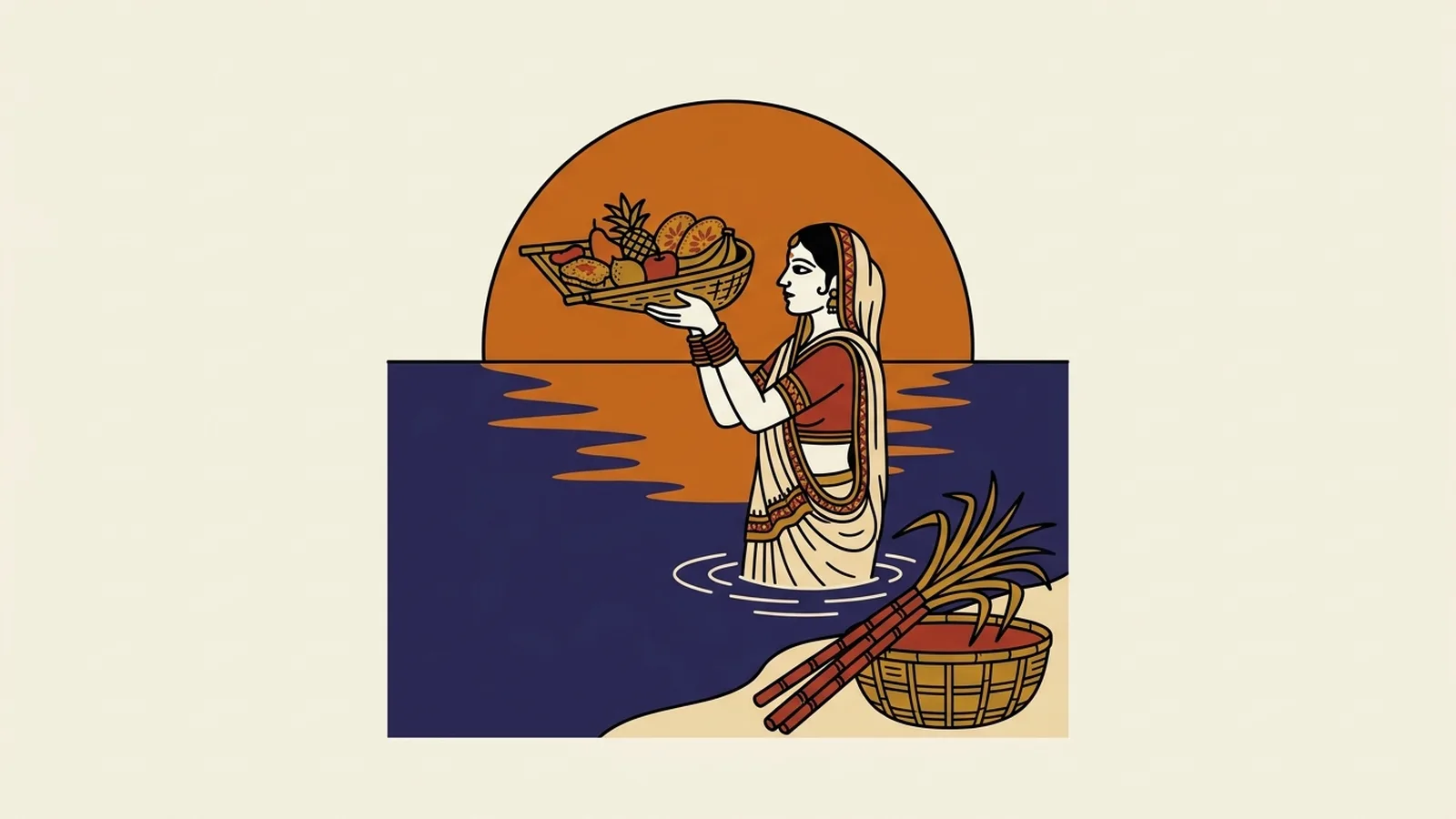
Chhath Puja illustration

Annual festival

Kartika Shukla Paksha

Chhath Puja 2026छठ पूजा

Chhath is a four-day festival of thanksgiving to the Sun and the goddess Chhathi Maiya, with offerings made standing in water at sunset and sunrise.

Date · New Delhi (28.6139° N, 77.2090° E)

Friday, 13 November 2026

Samvat

Vikram 2083 · Shaka 1948

Tradition harmony

All regional traditions Chakra tracks agree on this date:

North (Purnimanta)
13 Nov 2026
South (Amanta)
13 Nov 2026
Tamil
13 Nov 2026
Bengali
13 Nov 2026
ISKCON
13 Nov 2026
Smarta
13 Nov 2026

Tithi window

Begins 13 Nov, 6:41 am

Ends 16 Nov, 5:27 pm

Abhijit Muhurta

11:43 am – 12:26 pm

Universal auspicious midday span

Observance duration

Observed across 4 days

2026-11-13 through 2026-11-16

Masa note

Nija (Shuddha) Kartika

No intercalary month interference this year.

November 2026

S
M
T
W
T
F
S
2
3
4
12
13
14
15
18
19
23
25
26
28
29
30
  • 1 SunAhoi AshtamiAhoi Ashtami is a traditional fasting day observed by mothers for the long life and wellbeing of their children on Kartika Krishna Ashtami.
  • 6 FriDhanterasDhanteras opens the Diwali period and is considered auspicious for buying metal, and for honouring Dhanvantari and Lakshmi.
  • 7 SatNaraka ChaturdashiNaraka Chaturdashi commemorates the triumph of Lord Krishna and Satyabhama over the tyrant demon Narakasura on Kartika Krishna Chaturdashi.
  • 8 SunDiwaliDiwali is the festival of lights marking the victory of light over darkness and the return of Rama to Ayodhya.
  • 10 TueGovardhan PujaGovardhan Puja recalls Krishna lifting Mount Govardhan to shelter the people of Braj, and is kept the day after Diwali.
  • 11 WedBhai DoojBhai Dooj is the day at the close of Diwali on which sisters apply a tilak to their brothers and pray for their long life.
  • 13 FriChhath Puja(this page)Chhath is a four-day festival of thanksgiving to the Sun and the goddess Chhathi Maiya, with offerings made standing in water at sunset and sunrise.
  • 16 MonVrishchika SankrantiVrishchika Sankranti is the moment the Sun enters the sidereal sign of Scorpio, opening the month in which the Kartikai and Mandala pilgrimage seasons begin.
  • 20 FriDev Uthani EkadashiDev Uthani Ekadashi marks the awakening of Lord Vishnu from his four-month cosmic slumber, concluding Chaturmas and opening the Hindu wedding season.
  • 21 SatTulsi VivahTulsi Vivah is the ceremonial wedding of the sacred holy basil plant (Tulsi) to Lord Vishnu in the form of Shaligram on Kartika Shukla Dwadashi.
  • 24 TueKartik PurnimaKartik Purnima is the full moon of the month of Kartika, kept with river bathing, lamp offerings, and worship of Vishnu and Shiva.

Also this month: Ekadashi (2), Pradosh Vrat (2), Masik Shivratri (1), Amavasya (1), Vinayaka Chaturthi (1), Masik Durga Ashtami (1), Purnima (1), Satyanarayan Puja (1), Sankashti Chaturthi (1).

Local horizon calculations

City-wise timings

CityLocal dateTithi window (local)vs. New Delhi
New Delhi13 Nov 20266:41 am – 5:27 pmSame day
Varanasi13 Nov 20266:13 am – 5:09 pmSame day
Mumbai13 Nov 20266:44 am – 5:59 pmSame day
Bengaluru13 Nov 20266:17 am – 5:49 pmSame day
Kolkata13 Nov 20265:47 am – 4:52 pmSame day
Chennai13 Nov 20266:06 am – 5:39 pmSame day
London13 Nov 20267:14 am – 4:09 pmSame day
San Francisco12 Nov 20266:46 am – 4:58 pmDiffers

Tithi window shown in each city’s own local time — the underlying instant is the same worldwide.

Chhath is kept with unusual rigour. Over four days the devotee, often a mother on behalf of her family, bathes and eats a single sattvic meal, then fasts without water for roughly thirty-six hours, and finally stands waist-deep in a river or pond to offer arghya, first to the setting Sun and again to the rising Sun the next morning. Offerings of thekua, fruit and sugarcane are carried to the water in bamboo baskets.

The festival begins on the fourth tithi of the waxing fortnight of Kartika with Nahay Khay, followed by Kharna on the fifth, the evening arghya on the sixth (Shashthi, which gives the festival its name), and the morning arghya on the seventh. The two arghya rites are fixed to local sunset and sunrise.

It originates in Bihar, Jharkhand and eastern Uttar Pradesh and the Mithila region of Nepal, and has spread with migration to cities across India and abroad.

Multi-year archive

Chhath Puja in other years