
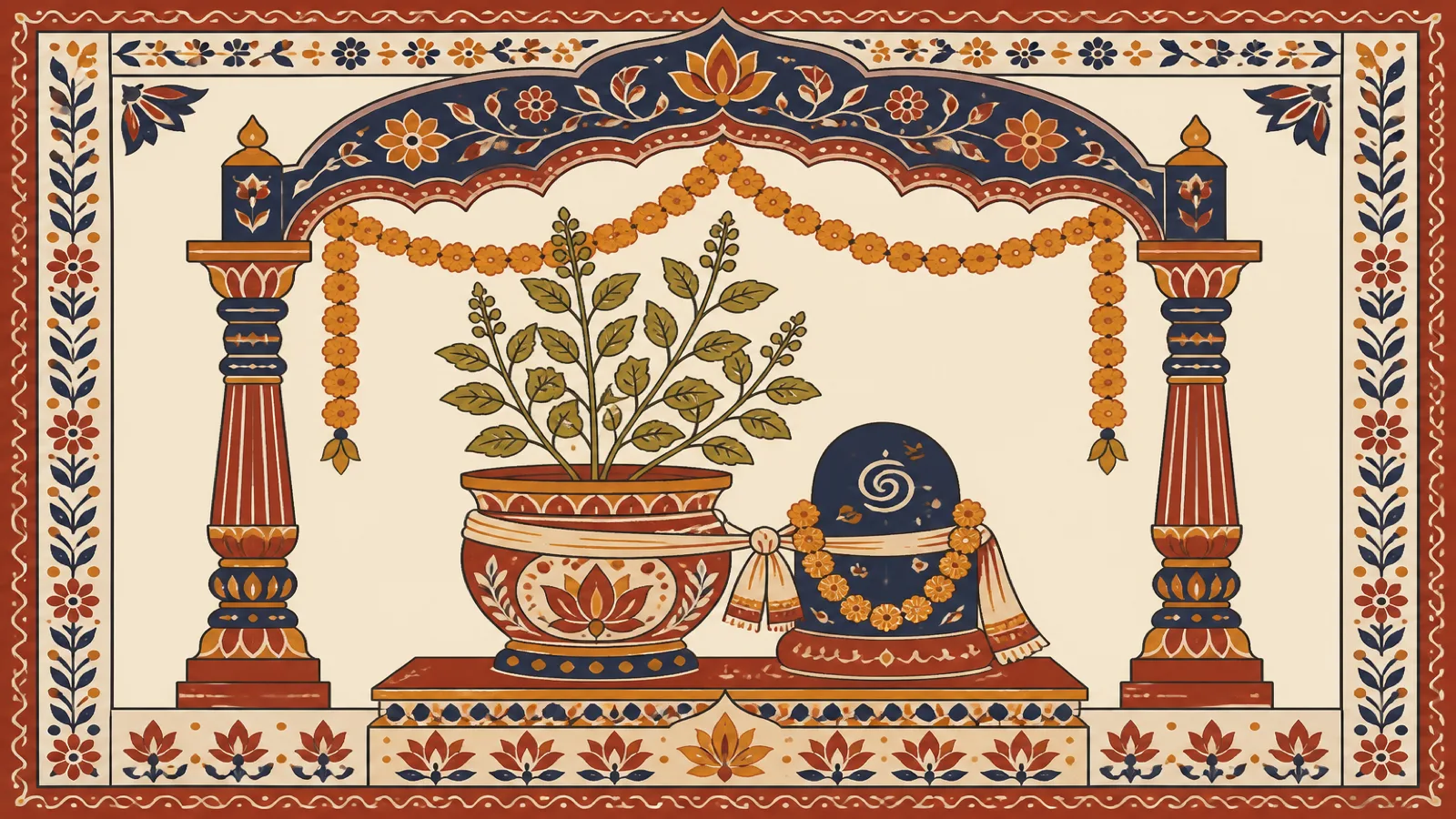
Tulsi Vivah illustration

Annual festival

Tulsi Vivah 2030तुलसी विवाह

Tulsi Vivah is the ceremonial wedding of the sacred holy basil plant (Tulsi) to Lord Vishnu in the form of Shaligram on Kartika Shukla Dwadashi.

Date · New Delhi (28.6139° N, 77.2090° E)

Wednesday, 6 November 2030

Tradition harmony

All regional traditions Chakra tracks agree on this date:

North (Purnimanta)
6 Nov 2030
South (Amanta)
6 Nov 2030
Tamil
6 Nov 2030
Bengali
6 Nov 2030
ISKCON
6 Nov 2030
Smarta
6 Nov 2030

Tithi window

Begins 6 Nov, 3:44 am

Ends 7 Nov, 4:23 am

November 2030

S
M
T
W
T
F
S
1
3
4
6
8
9
11
12
14
15
17
18
19
20
22
24
26
27
29
30
  • 5 TueDev Uthani Ekadashi →Dev Uthani Ekadashi marks the awakening of Lord Vishnu from his four-month cosmic slumber, concluding Chaturmas and opening the Hindu wedding season.
  • 6 WedTulsi Vivah(this page)Tulsi Vivah is the ceremonial wedding of the sacred holy basil plant (Tulsi) to Lord Vishnu in the form of Shaligram on Kartika Shukla Dwadashi.
  • 10 SunKartik Purnima →Kartik Purnima is the full moon of the month of Kartika, kept with river bathing, lamp offerings, and worship of Vishnu and Shiva.
  • 16 SatVrishchika Sankranti →Vrishchika Sankranti is the moment the Sun enters the sidereal sign of Scorpio, opening the month in which the Kartikai and Mandala pilgrimage seasons begin.

Also this month: Masik Durga Ashtami (1), Ekadashi (2), Pradosh Vrat (2), Purnima (1), Satyanarayan Puja (1), Sankashti Chaturthi (1), Masik Shivratri (1), Amavasya (1), Vinayaka Chaturthi (1).

Local horizon calculations

City-wise timings

CityLocal dateTithi window (local)vs. New Delhi
New Delhi6 Nov 20303:44 am – 7 Nov, 4:23 amSame day
Varanasi6 Nov 20303:44 am – 7 Nov, 4:23 amSame day
Mumbai6 Nov 20303:44 am – 7 Nov, 4:23 amSame day
Bengaluru6 Nov 20303:44 am – 7 Nov, 4:23 amSame day
Kolkata6 Nov 20303:44 am – 7 Nov, 4:23 amSame day
Chennai6 Nov 20303:44 am – 7 Nov, 4:23 amSame day
London6 Nov 203010:14 pm – 6 Nov, 10:53 pmSame day
San Francisco6 Nov 20302:14 pm – 6 Nov, 2:53 pmSame day

Tithi window shown in each city’s own local time — the underlying instant is the same worldwide.

Tulsi Vivah is a joyous ceremonial ritual marking the symbolic marriage between the holy basil plant (Tulsi, an incarnation of Goddess Vrinda) and Lord Vishnu, venerated in the form of the sacred Shaligram stone or an image of Krishna. It takes place between Prabodhini Ekadashi and Kartik Purnima, traditionally on the twelfth day (Dwadashi) of Shukla Paksha in the month of Kartika.

The ceremony mirrors traditional Vedic wedding rites: the courtyard around the Tulsi planter is swept, painted with rangoli, and enclosed by a canopy of sugarcane and banana stems. Devotees recite Mangalashtaka mantras, shower flower petals and unbroken akshata rice, and tie a ceremonial holy thread joining Tulsi and Shaligram.

In Hindu tradition, conducting Tulsi Vivah is regarded as conferring the spiritual merit of performing Kanyadan (giving a daughter in marriage). The ritual heralds the resumption of the annual Hindu wedding season following the conclusion of Chaturmas.

Read and recite

The katha and prayers for Tulsi Vivah

Multi-year archive

Tulsi Vivah in other years